The Manchester Alexander Technique
Training School Est. 2001
MATTS Alexander Technique Professional Resources: An Alexander Technique Teacher Training Archive
Resources: Home | Public Resources | Teacher and Trainee Resources | Video Library Archive | Video List | Site Search
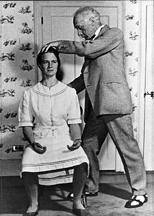


Welcome to the Manchester Alexander Technique Training School (MATTS) Video Archive. This public index outlines the extensive resources available to website members.
Our private members' area contains a library of over 100 hours of video lectures, talks, workshops, and demonstrations from some of the most notable contemporary Alexander Technique (AT) teachers, together with an anatomical series, a series of lectures on Alexander's books and guided practical work. Below you will find a thematic guide to a selected overview of our archives. The archive includes talks, demonstrations and discussions with Alex Murray, Anne Battye, Robin Simmons, John Nicholls and at least ten other current and past heads of STAT-approved training courses.
These materials are primarily intended for teachers, trainee teachers and long-term students of the Alexander Technique, and may also be of interest to others who wish to explore the work in more depth.
How to use this index
Access to this archive is restricted because most of the classes took place in a private setting. While the full-length video and audio recordings are hosted within our private members' area, this public index allows you to explore the depth of our curriculum and the expertise shared at MATTS. None of this material is currently available elsewhere.
Access to the Members' Area
If you are a qualified teacher of the AT, a trainee on any STAT course, or a student who regularly visits our school, you can sign up for access to our Members' area - it only takes a minute.
[Apply for Member Access] | [Existing Member Login]
1. Expert Masterclasses: Theory, Performance and Clinical Applications
Our library contains many recordings that are not available elsewhere from some of the most influential and subject-specific expert teachers in the contemporary international AT community.
Theory & History:
-
The Dart Procedures: An examination of evolutionary movement, the 12 cranial nerves, and the front/back spiral systems (Lectures by Alex Murray & Robin Simmons)
-
The Means-Whereby vs. End-Gaining: Understanding the difference in pedagogical approaches when teaching. (Jean Fischer)
-
Sensory Appreciation & Kinaesthetic Re-education: An exploration of "Reliable Sensory Appreciation" - balancing the classic "don't try to feel" instruction with the reality of re-education. (Jean Fischer)
-
Non-Doing & Mirror Work: Practical games and tutorials on the core concept of "non-doing" and using mirrors in a teaching practice. (Malcolm Williamson)
-
International Perspectives: Teacher training courses in Germany and Israel in the 1980s. (Mike Trautmann)
-
The Lineage of F.M. Alexander: Studying the traditions of Marjorie Barstow and group/application work. (John Nicholls)
-
Direction: A lesson in Direction from first generation teacher George Trevelyan. (John Hunter)
Advanced AT Theory & Pedagogy: Specialized presentations addressing the "intangibles" of the AT.
-
Defining "Direction": A panel discussion on the critical differences between thinking, feeling, and doing. (Peter Bloch, Malcolm Williamson and others)
-
The Purpose of "Hands-On": An analysis of why tactile feedback is used in teaching and the goals of manual guidance. (Malcolm Williamson)
-
An exploration of the use of the hands on teaching and its relationship to the teacher's general and specific intentions and attitudes to the work and to their students. (Peter Bloch)
-
What does it Mean to "Go Up": Exploring what AT teachers mean by "going up". (Peter Bloch)
-
The Inclusivity in Teaching: Case studies on teaching students with learning difficulties and dementia, showing that cognitive barriers are not necessarily obstacles to understanding the AT. (Peter Bloch)
-
The philosophy of "Attitude" and Psychological Change. How AT facilitates behavioural change at a psychological and spiritual level through "Attitude" and inhibition. (John Nicholls)
-
Defining Inhibition and Direction: A panel discussion. (Jamie McDowell, Peter Bloch, Malcolm Williamson, Brita Forsstrom)
-
Performance & Movement:
-
The AT in Professional Sport and Athletic Performance: Applying the "principles" to tennis and elite coaching at an Ivy League University. (Gary Adelman)
-
The Mechanics of Walking: From semi-supine to active movement; a practical exploration of transitioning from standing to walking. (Paolo Frigoli)
-
The Anatomy of Motion: Specialised tutorials on the ankles and the biomechanics of lifting weights. (Dorothea Magonet)
-
Working with a Student on the Table: A masterclass. (Anne Battye)
-
Voice Work & Spirals: Integrating whispered 'ah' work and spiral movements into the practice. (Sue Fleming)
-
The Actor’s Connection: 50 years of teaching the Alexander Technique at the Royal Academy of Dramatic Art (RADA). (Anne Battye)
-
Teaching Alexander Technique at Music Conservatoires: A panel with three teachers, each of whom have spent more than 40 years teaching in a major national conservatoire. (Malcolm Williamson, Dorothea Magonet, Pauline Wetherell)
-
Medical & Clinical Applications:
-
Scoliosis and Spinal Health: Detailed talk and demonstration on addressing spinal twists, teaching pupils with scoliosis, and working with leg-length discrepancies. (Emily Bancroft)
-
Modern Clinical Research Overview: A critical look at the significance of clinical research for AT teachers and how the Technique is presented in major medical journals. (Julia Woodman)
-
Fascial Connections: Exploring the anatomy of the diaphragm and the role of fascia in movement. (Brita Forsstrom)

2. Core Training Curricula (Series)
Our video library includes a number of systematic courses designed to support teacher training and continuing professional development (CPD) including:
1. Anatomy & Physiology course:
A 25-part series by Sallie Bancroft specifically tailored for AT teachers and trainees. This series explores the mechanical aspects and consequences of mobility and posture and the biological reality of "Use." Each talk is accompanied by high resolution downloadable slides, related information and links. A few of the subjects covered include:
-
The Axial Skeleton: Head, neck, joints, pelvis, and thorax.
-
Muscular Systems: Detailed studies of the muscles of the back, face, throat, and tongue, plus specialized sessions on the diaphragm and psoas muscle.
-
An exploration of the mechanical consequences of "the head going back and down" versus "the head going forward and up" with many interesting diagrams capturing the heavy price paid for heading in the wrong direction!
-
The Appendicular Skeleton: The biomechanics of the shoulder girdle, arms, elbows, wrists, and hands.
-
Functional Systems: The anatomy of breathing, speech, voice, chewing, swallowing and respiratory function (breathing).
2. Historical & Philosophical Foundations: Man’s Supreme Inheritance
A comprehensive 20-part lecture series by Malcolm Williamson (for 17 years the head of training of MATTS) analyzing F.M. Alexander’s seminal text, Man’s Supreme Inheritance (MSI) from the historical, philosophical, educational context, including a frank and full discussion of FM's early racism based on a misunderstanding of Darwin's theory of evolution in this rare and expert exploration of Alexander's first book. The series is accompanied by notes on each lecture and discussion and links to further information. Topics covered include:
-
Conscious Control & Habit: Exploring the transition from "fixed habits" to "changeable habits" and the application of conscious control.
-
Use, Structure, and Function: Theoretical frameworks including the role of the Vagus nerve and the "stutterer" case study.
-
Evolution & Ethics: A critical modern look at Alexander’s use of Darwinian theory and a necessary, transparent discussion on addressing historical racism within foundational texts.
-
Ergonomics & The 'Monkey': Practical applications of AT principles in modern environmental design and daily movement.
-
Making a Choice: The foundation of the Technique
-
The Problem of "Attitudes": how these can create a block to learning and can lead to a lack of a sense of purpose, doubt, credulity, over-caution, over-passivity (over relaxed), lack of engagement, loss of ‘wholeheartedness', feelings of disempowerment or disengagement with one's own state of health.
3. Professional Skills: Reflective Practice
A 6-part series and a separate one hour summary of the longer course by Karen McCarthy on Reflective Practice (RP). A vital skill for the modern AT trainee, and useful for everyone, RP enhances continuous learning, and is therefore of particular relevance to AT teaching and learning and is an important supporting skill for integrating the training at MATTS.
Karen is an experienced practitioner and teacher of Reflective Practice, which she has taught at both degree and postgraduate levels at the University of Manchester.
Here Karen presents an exploration of RP to help start, or support the further development of, both teachers and trainees on the path of using this remarkable tool to enhance our work.
The series is accompanied by colourful slides, available to download.

3. Practical Tools & Experimental Learning
1. Directed Activities/Indirect Procedures: Alexander Technique "Games"
We use "games" as a sophisticated pedagogical tool to explore inhibition and direction in a low-pressure, experimental environment. Games are the application of the principles of the Technique to everyday activities. There are nearly 30 videos of guided games in our Archive, and here are a few examples:
-
The Philosophy of 'Games': What are games, why we use them systematically in AT training, and how they facilitate deeper learning. (Peter Bloch).
-
Applied Performance & Skill:
-
Musicians & The Arms: Using the arms and hands in high-performance contexts. (Janet Pinder-Emery).
-
Voice & Articulation: Specialized games for the pharynx, tongue, and throat. (Sue Fleming).
-
Handwriting & Fine Motor Skills: Applying AT principles to the act of writing. (Janet Pinder-Emery).
-
-
Inhibition & Cognitive Science: Using the Stroop Test to practically explore the mechanism of inhibition. (Malcolm Williamson).
-
Daily Movement & Mechanics: Experimental sessions on the "Flying Monkey," balancing on feet, kneeling, walking, and the mechanics of "bending." (Alison Marsden, Gillian Pierce).
-
Coming up from "semi-flex" ('monkey) without disturbing the length of the back. (John Nicholls)
-
Teacher Development: Masterclasses on the "Use of Hands" on oneself and the general directions of hands in teaching. (Janet Pinder-Emery)
2. The Semi-Supine (Constructive Rest) Archive
Our library features a comprehensive archive of theoretical lectures on the history and purpose of semi-supine and a large collection of guided audio sessions.
-
Theory: The history and purpose of "lying down". (Peter Bloch, Malcolm Williamson)
-
Investigating the most effective positions to adopt and how to Direct in semi-supine. (Peter Bloch, Malcolm Williamson, Karen Wentworth).
-
"A History of Lying Down" and why we practice constructive rest. The science behind the procedure. (Malcolm Williamson)
-
Guided Audio: A library of over 20 unique guided audio sessions led by senior teachers. (Jamie McDowell, Paolo Frigoli, Brita Forsstrom, Malcolm Williamson and many more). Many of these sessions use guided practice to explore related topics such as breathing, whispered "ah", eye movements, a prone variation of the traditional supine, and Dart Procedures.


4. Visual & Historical Archives
Our Members' Gallery contains a curated collection of more than 70 photographs of special interest to students and teachers of the Technique including:
-
F.M. Alexander Historical Gallery: High-resolution images of F.M. Alexander and early teachers.
-
Comparative Studies of "Use": A visual library showing striking examples of "good use" vs. "poor use" in everyday activities and professional performance, and a few humorous items for students of the Technique. From Fred Astaire and a sprinting cheetah to Carl Sagan and Dominic Cummings!
A full indexed list of the videos and audios in our collection.
The Library is a comprehensive archive of pedagogical research, historical lectures, downloadable books, pdf resources, peer-reviewed articles, STAT documents and clinical studies for teachers, trainee teachers and advanced students of the Alexander Technique, several of which are not available in digital form elsewhere.